Experience
In the dominican republic
Intern at COIN, Summer 2015
At the Centro de Orientacion e Investigacion Integral (COIN) I gained 64 hours of experience conducting Pre and Post counseling sessions for HIV and other STIs, participating in 2 outreach events at a high risk rural neighborhood for HIV conducting rapid testing, attending leadership workshops for trans individuals, and co-leading consultations working on HIV treatment adherence for positive clients.
The COIN is located at a high risk neighborhood for sex work, STIs, and crime in Santo Domingo (the capital of the country). At the center,where most of the work was done, I felt I made a change in society. Every day I encouraged clients to take care of their sexual health, to become agents of their sexuality, and to raise awareness of the HIV pandemic in at-risk populations (LGBT+, sex workers, immigrants, and drug users). Also, this experience made me aware of the global health issues existing in certain geographical locations, and my home place, the island of La Hispaniola. Haiti and the Dominican Republic have the highest shared rate of HIV in the Caribbean. Dealing with global issues in my home country made me self aware of my ability to impart awareness into someone's life to change for their health. This equipped me to become culturally sensitive to LGBT+ issues, to research and humble myself to their context, to learn not to judge others by our differences, and it propelled my drive to work on health prevention and mental health globally.
Intern and Shadowing at CESIC, UNIBE, Summer 2014
At the Centro de Estudios e Intervencion de la Conducta (CESIC), a therapy center at the Universidad Iberoamericana in Santo Domingo, Dominican Republic, I interned and shadowed co-conducting and observing therapies for kids with learning disabilities, and for adults seeking family therapy. Learning the in-person rapport needed to establish trust with clients was pivotal in this center. From working with kids and 1 teenager, one had to appreciate and consider their social context and life factors. I became empathetic to enable someone to overcome their life struggles and the stigma related with the "abnormal" label given to them. Most importantly, I learned to observe the different methods and measures existent in another system for mental health. Comparing the Dominican Republic and the USA I learned to incorporate different methods from each, and have a wider perspective into mental health.
The most touching experience at the CESIC was my visit to a girls' reformatory institute. It was for girls who were under 18 years old and had commited crimes, mostly homocide and robbery. Our project consisted of administering cognitive tests and HIV rapid tests to 18 girls aging from 14-18 years old, from which 3 were pregnant, and most of them admitted to the institute for homocide. This project showed me how intersecting factors such as gender, socioeconomic status, geographic area, and race can put individuals more at risk for crimes, HIV, mental health issues, and social stigma.This realization sparked my interest in prevention programs, research development for health and social disparities, and to seek justice and equity for underserved populations that do not have access to resources to live a healthy life.
in the usa
Medical Case Manager at METRO Inclusive Health and EPIC, June 2016-August 2021
EPIC and METRO are both non-profit organizations ain Pinellas and Hillsborough counties that provide services and resources to individuals with HIV/AIDS. Working in both locations: Pinellas and Hillsborough counties, I grew sensitive and aware of the differences in health care, demographics, and needs of the populations for each county. I provided case management for 75+ clients who have positive HIV/AIDS diagnosis in order to maintain a healthy lifestyle, promote their well being, and link them to resources as needed. I played a key role in doing outreach and providing multi culturally competent services with the Hispanic/ Spanish-speaking community of both counties as a bilingual speaker. My duties fell under a diverse range: provide FREE rapid testing for HIV, make sure my 75+ clients were in care and stay adherent to Ryan White program requirements, link high-risk clients to resources as need be, and manage support groups in spanish for HIV+ individuals. I saw clients with needs for substance abuse rehabilitation, domestic violence recovery, linkage to care for HIV, mental health counseling/therapy, etc. My job really shed light into the health disparities and chain of factors that play into the epidemiology of HIV, other diseases, social factors, and mental health.
Practicum and Volunteering at Wellflorida Council, High Impact Prevention program, August 2015- May 2016
The Wellflorida Council is a non-profit organization that serves 16 counties in North Florida with health planning and projects. I did a practicum and volunteering for the High Impact Prevention program for HIV. My role as a practicum student and volunteer for the HIP program consisted of recruiting prospects to get tested during outreach programs and events in the local 4 counties (Alachua, Marion, Putnam, Columbia and Lake in Florida), attending safer sex education events, and carrying out my own HIV testing event at a Farmers' market event in Gainesville. The main outreach events were at night clubs, a center for homeless/temporary housing, university events, tattoo businesses, etc. I became certified to perform oral tests for HIV, and got to educate individuals to understand the importance of getting tested adapting myself to different settings.
Doing outreach in these various settings equipped me to adapt to different people, contexts, stereotypes about HIV, and perspections. As such, I had to learn how to tackle the myths about HIV, the fears of this pandemic people have, and to relate to individuals regardless of their race, ethnicity, socioeconomic status, literacy, and religion. Thanks to my experience at the Wellflorida Council I grew aware of my own biases and privileges. As such, I had to step out of my comfort zone, become self-aware, accept constructive criticisms, and learn to respect and address the LGBT+ population on an equal manner.
Resident Assistant, UF Department of Housing, August 2013-May 2016
For 3 years as an undergrad I had the opportunity to work as a Resident Assistant for the University of Florida. Working as an RA allowed me to live the residence life experience that the American society upholds. In Dominican Republic students commute, so living on campus is not something practiced as much. School is for studying, and that is it. Yet, as an RA I was able to indulge in this American cultural experience and take leadership as well. This job equipped me to act as a resource for residents, link them to campus resources, be a role model, and work in a holistic way. It was not all aout paperwork or hours, but caring for the residents, carrying out programs based on their needs, and learning to plan large scale events.
From the RA job the most valuable skills obtained were to actively listen, and to learn when and how to speak. This was one of the main reasons I did this job, as I wanted to change students' lives in small ways. I learned and was trained to listen to people, to not dismiss their problems and feelings, and to intervene when needed. This became pivotal during crises intervention, as I had to respond to various cases of alcohol intoxication, sexual assault, roommate conflicts, and depression. I learned the profound meaning for someone to be able to vent, speak without being judged, and be appreciated as a person. As an RA I experienced ways to counsel and appreciate the effects of little therapeutic moments in day to day life.
in france
Intern at Inlingua Provence, March-May 2015
During my semester abroad in France (Aix-en-Provence), I did a 2-month internship with a language institute named Inlingua. Inlingua is an international language teaching organization located in 38 countries. It especializes in teaching languages for professional development and personal marketing. I interned at the center in Provence, France. I partook of adult teaching sessions at the center, and also animation sessions with middle schoolers at a vulnerable zone 20 mina away in Marseille, the 2nd biggest city in France. My biggest task was to help develop and construct a pilot afterschool program to support kids in underserved areas in Marseille. This program entailed creating a weekly lesson plan, getting all the materials needed, and going to our assigned school every friday to conduct interactive English lessons for school kids; this was done through arts and crafts, singing, dancing, etc. This was an arduous task, since this was a model template for a national French program, I do not identify as a teacher or instructor, and my class was the rowdiest in the whole school. Yet, I still persevered to give my best, do my best for the kids, and adapt to extraneous situations. I was definitely not as willing to teach kids, but I became grateful for this experience as I saw first hand how the stereotypes of high-crime zones and their conditions affect access to school and resources, and how these factors reinforce a negative cycle in these communities. Once again, I observed how global systems of oppression manifest in a different society.
Thanks to Inlingua I immersed myself and discovered the French labor system, and learned the different policies and
values in France. For example, I learned that after 2 months of labor the French system requires the employer to pay a worker. This is why internships cannot extend for more than 2 months. I also realized that time and presence is not pivotal for the French; they were not as pressured to be on time, and arriving late had more leniency. As an outsider I reflected on the values and positives of another culture's laboral structure. At Inlingua I had the opportunity to incorporate my multicultural thinking to provide competent and sensitive service to culturally diversed and underserved kids.
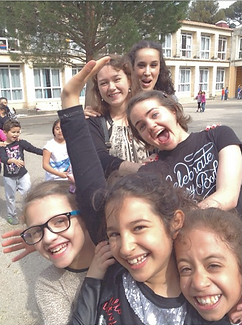
Me and 2 other "animatrices" with our little mischieveous french angels.